
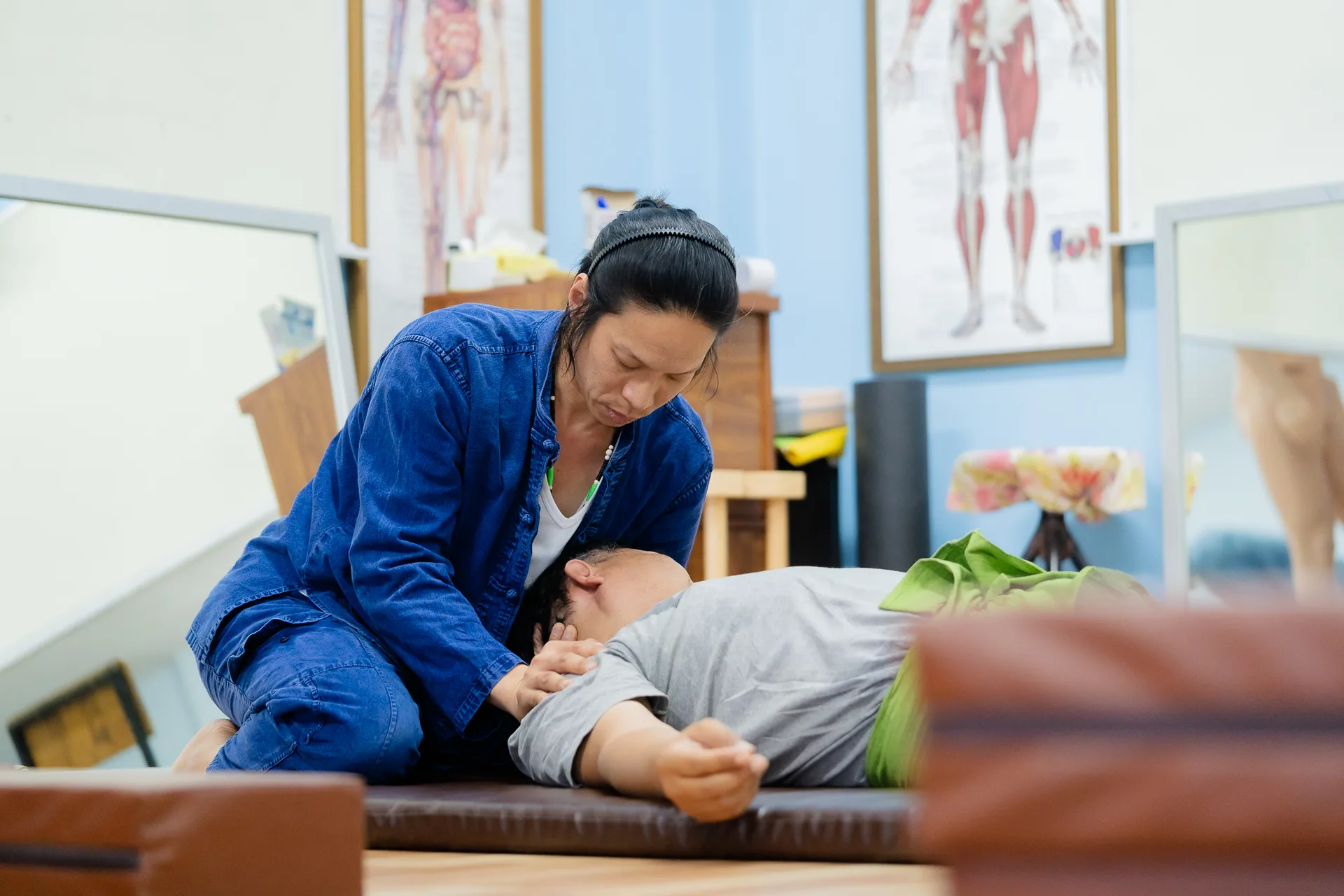
Quick answer — Massage does not "straighten" adult scoliosis: the bony curve is what it is. However, most of the daily discomfort comes from the asymmetric muscle tension organised around the curve — and that responds very well to manual work. The goal: less pain, more mobility, better tolerance of effort.
A scoliosis discovered in adolescence, then decades of managing a "particular" back: one side always tighter, quicker fatigue, pain in waves. That daily reality can improve.
What scoliosis does to muscles
Around a spine that rotates and tilts, the musculature organises itself in permanent asymmetry: on the concave side, shortened, dense muscles; on the convex side, lengthened muscles working in restraint. Neither operates in good conditions — hence fatigue, recurring contractures and areas that always "lock" on the same side. Over the years this asymmetry stiffens if nothing maintains it. Many notice it in daily life: the bag always carried on the same side, discomfort building at the end of a seated day, the hike that "pulls" more on one side than the other.
Being honest about goals
It is one of our three commitments: results as the only judge. Manual work does not change the curve's angle — monitoring the scoliosis itself belongs to your physician. It acts on everything else: muscle pain, stiffness, sleep quality, tolerance of prolonged sitting or standing. For many adults, that "everything else" is precisely what weighs on daily life. In practice, progress is measured in simple terms: carrying the groceries without bracing, sitting through a meeting without constantly shifting, gardening without paying for it for three days.
A necessarily tailor-made protocol
No two scolioses are alike: the assessment maps your own pattern — curves, rotations, overworked areas, compensations down to hips and shoulders. The protocol releases the shortened side in depth, relieves the overworked side, and restores mobility where it remains available. Session-to-session tracking refines the map. Complementary active work (adapted core training, swimming) consolidates — see also Low back pain: why it always comes back for the frequent lumbar component. Depth and pace adjust to your feedback at every stage.
When should you see a doctor?
Some signals call for medical advice before any manual work: new, intense or night-time pain; a curve that seems to be increasing; tingling, weakness or loss of sensation in a limb; unusual breathlessness. Beyond that, any significant scoliosis deserves periodic radiological follow-up, even without symptoms. Manual work complements that follow-up, never replaces it — and the assessment redirects you frankly if your situation calls for it. These cases are the exception; they simply need to be ruled out first.
Self-care between sessions
Between sessions the goal is simple: maintain the mobility gained and avoid feeding the asymmetry. Adapted core work stabilises without compressing; swimming lengthens and spreads the effort; the concave-side stretches shown in session keep the shortened side available. At the desk, varying your support points and standing up regularly stops the pattern from setting — long seated hours are the quiet enemy of scoliotic backs. On the bedding side, a mattress that supports without sagging helps the back spend the night in a neutral position. Nothing heroic: regularity.
FAQ
Can my scoliosis still progress in adulthood? Larger curves can progress slowly; periodic medical monitoring remains essential in parallel.
Is massage safe with scoliosis? Yes, for adapted muscular work. The assessment rules out situations requiring prior medical advice.
Can I do sport? Not only possible but recommended: a maintained, mobile scoliotic back tolerates daily life far better.
Which mattress with scoliosis? Neither a plank nor a hammock: firm support with a softer surface layer, respecting the curves without letting the pelvis sink. Testing over several nights beats any spec sheet.