Quick answer — The Thara Massage Institute of Chiang Mai offers a structured online curriculum: six core courses organised by body region, anatomy modules, advanced specialisations and free resources. These trainings are aimed mainly at practitioners. On the Swiss side, a video academy is in preparation to extend this transmission.
Thara Massage is not only a treatment you receive: it is a discipline that is passed on. Master Ajahn Suwat has structured decades of practice into a complete training programme, part of which is accessible online from anywhere in the world.
A curriculum organised by body regions
The heart of the online curriculum is the six Core Courses, each dedicated to one region and its conditions. The first covers headaches, neck pain and upper back pain — around twenty conditions on its own. The following ones move down the body: mid and lower back, paravertebral chains, upper limb, lower limb (around twenty conditions as well), then abdomen and groin region.
This organisation says something essential about the method: you don't learn "massage moves", you learn to treat precise clinical pictures. Frozen shoulder, tennis elbow, sciatica — the very syndromes we describe on this blog and treat at the practice. The logic is the same from Chiang Mai to St-Cergue: identify the cause, run the appropriate protocol.
Anatomy, breath and advanced techniques
Around this foundation, the institute offers complementary modules. A twenty-four-hour gross anatomy course details bone, joint and muscle structures and sets them against the energy lines of the tradition — the famous "En", a bridge between modern anatomy and Thai knowledge. Breath-management courses ("Air Bender") train the practitioner's respiratory control. The most advanced students access safe joint mobilisation techniques or Ayurvedic-inspired pulse diagnosis.
The institute also provides free resources: a complete course on the muscular system, a fundamental treatment manual and an integration test to validate one's learning. Paid course fees are set in Thai baht — the equivalent of a few dozen to a few hundred francs — a deliberate accessibility, true to the tradition's spirit of transmission.
Who are these trainings for?
Let's be clear: these courses primarily target practitioners — massage therapists, bodyworkers, students of manual disciplines. Most content is in Thai, with detailed visual materials. This is not a "Sunday wellness" programme: it is the curriculum that trains, at a distance, people who already practise.
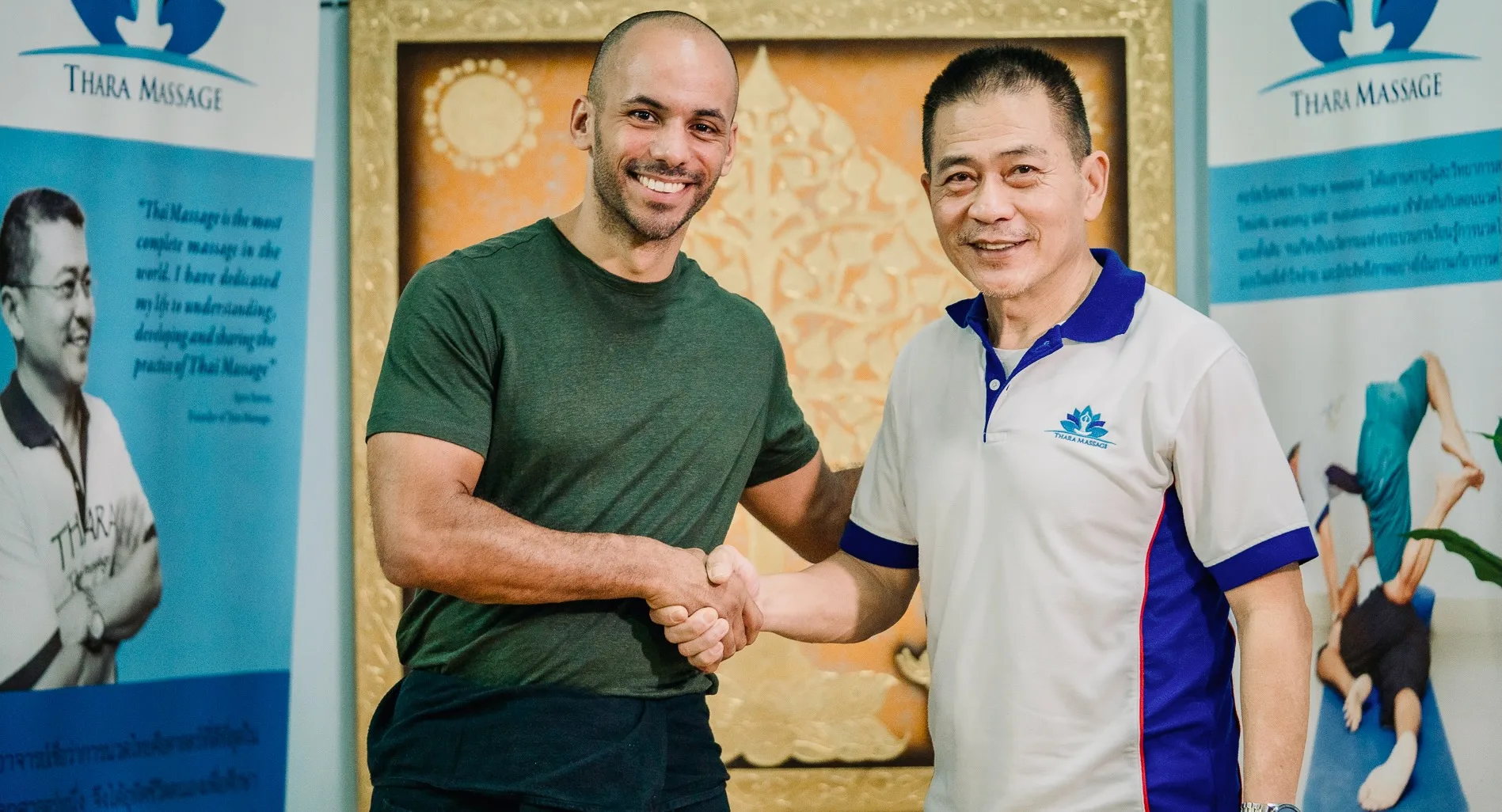
For a Swiss client, knowing this programme exists still has real value: it shows the level of demand behind every session. When you book a therapeutic massage at Swiss Thara Massage, you receive the direct application of this curriculum — transmitted to Clement Ramanich not online, but in person, at the institute, as explained in our article Swiss Thara Massage: the Swiss branch of the Thara Institute of Chiang Mai.
And on the Swiss side? An academy in preparation
The transmission does not stop in Chiang Mai. Swiss Thara Massage is preparing an online video academy: the teachings from the institute's channel will be gathered there, organised into structured paths — with, in time, dedicated French-language content on self-care between sessions: simple movements, stretches, ergonomics. The goal is the same as in our sessions: making everyone more autonomous with their pain, as the third step of our method intends — see What is Thara Massage? Origins and principles.
In the meantime, the blog already plays this role: every article ends with self-care advice drawn directly from this school.
FAQ
Do you need to be a practitioner to take the online courses? For the core and advanced courses, yes. The free resources (muscular system, basic manual) are open to anyone curious.
Are the courses available in English or French? Mostly in Thai. That is one reason for the upcoming Swiss academy and for our French/English content.
Is online training enough to practise Thara Massage? No. It complements, structures and deepens — but full transmission requires supervised practice, like the one Clement received at the institute.
How can you benefit from this method without training? By receiving it: book a session at the St-Cergue practice or at home across Geneva and La Côte.