Quick answer — Thara Massage is a therapeutic massage method practised and taught for over 30 years by Master Ajahn Suwat in Northern Thailand. Its speciality: deep release of the muscular and tendinous chains to resolve musculotendinous syndromes and chronic pain. It is practised clothed, on a floor futon, without oil.
Behind the words "Thai massage", two worlds coexist: tourist relaxation, and a demanding therapeutic tradition passed from master to student. Thara Massage belongs to the second.
A lineage, not a trend
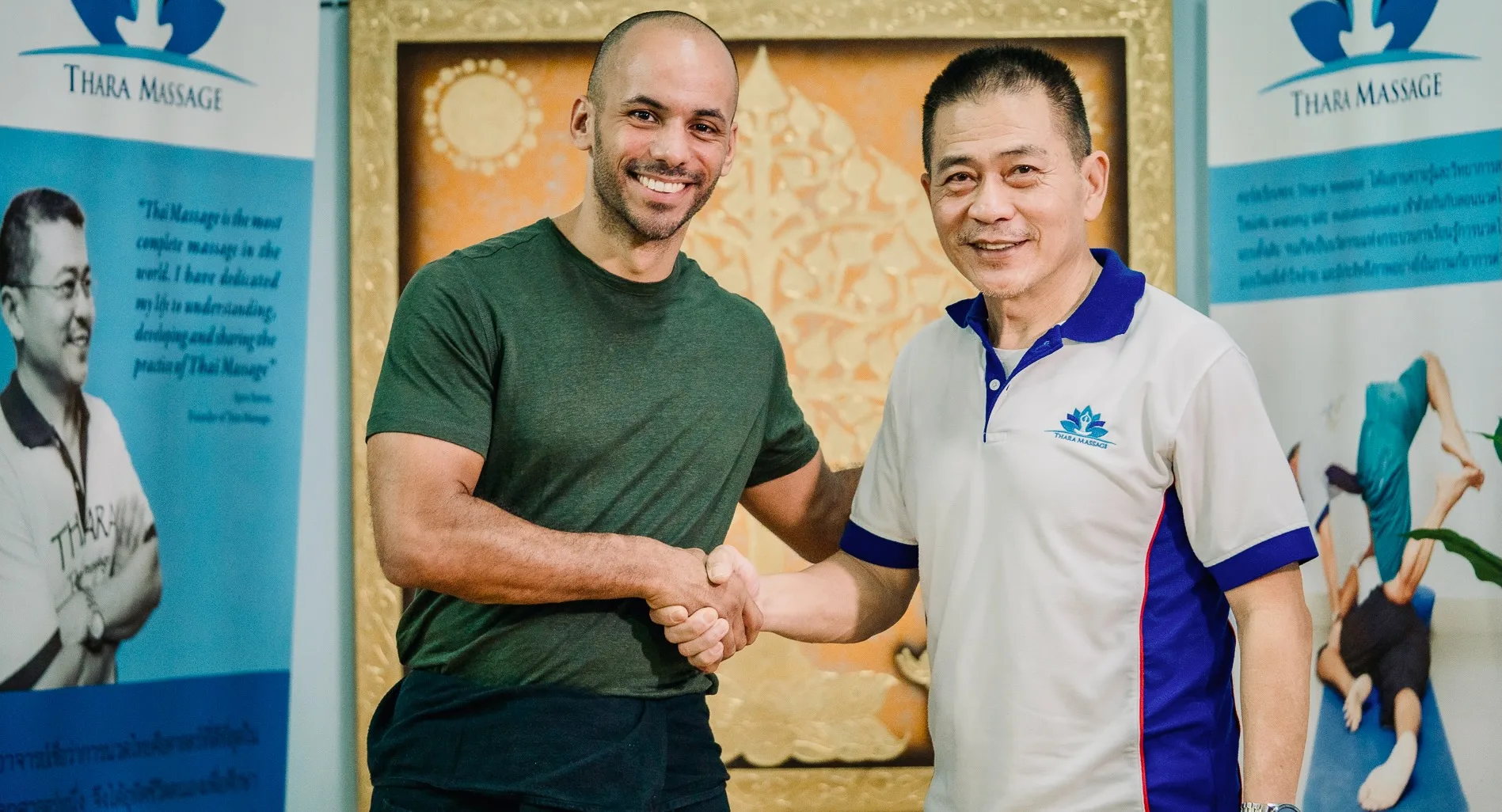
The Thara method grew from the practice of Master Ajahn Suwat, who has taught it for more than thirty years in Northern Thailand. Transmission follows the traditional path: long years alongside the master, working on real cases. That is the path Clement Ramanich followed, becoming one of his closest students before bringing the craft to Switzerland. The technique proved itself long before crossing continents — one of our three founding commitments.
In this tradition, no one improvises as a practitioner: every technique is learned under supervision, corrected, repeated on real cases over years. Ajahn Suwat passes on a standard as much as a technique — read a body before touching it, adjust every pressure to what the tissues give back.
The principles: cause before symptom
Thara Massage differs from relaxation massage in its clinical logic. Every course of care follows three principles: an assessment before any treatment — posture, tension, range, history of the syndrome; an individualised protocol — one problem = one solution, never a one-size-fits-all routine; results as the only judge — progress is reassessed each session, and if your case belongs with another professional, you are referred. The difference from wellness massage is detailed in Therapeutic or relaxation massage: which one do you need?.
What a session looks like
Work takes place on a floor futon, in the Thai tradition — a stable base allowing depth impossible on a table. Practitioner and patient stay clothed (soft, comfortable wear), no oil; a balm may be used if needed. Deep pressure, mobilisations and stretches target the muscle chains identified at assessment. Sessions last 60 or 90 minutes depending on the syndrome, at the St-Cergue practice or at home across Geneva and La Côte.
Your first session, step by step
The first meeting starts with a conversation: your history, your pain, current treatments, what you have already tried. Then comes the assessment itself — postural observation, range-of-motion tests, palpation of the muscle chains — leading to a reading of your syndrome, explained in plain terms. Floor work then fills the heart of the session, at an intensity adjusted with you throughout. It closes with a quick reassessment and a few self-care pointers. Just bring soft, comfortable clothing; the futon and equipment are provided, at the practice and at home alike.
Who is the method for?
Desk workers glued to their screens, athletes whose tendinopathy drags on, seniors who want to preserve their mobility — anyone whose pain keeps returning. A few situations, however, call for prior medical advice or an adapted approach: fever, recent trauma, phlebitis or circulatory disorders, severe osteoporosis, pregnancy. This common-sense triage is an integral part of the assessment — that, too, is what makes a practice therapeutic.
FAQ
Is Thara Massage painful? Deep work can be felt, but intensity stays controlled and continuously adapted — never endured pain.
What is it indicated for? Musculotendinous syndromes (tendinopathies, frozen shoulder, carpal tunnel…), chronic back and neck pain, postural issues, stress-related tension.
Is one session enough? A recent complaint may resolve quickly; an established syndrome requires a followed course of care, honestly defined at the assessment.
Do I need a medical prescription? No, access is direct. If your situation first requires medical advice, the assessment will tell you frankly: the method complements medical care, never replaces it.