
Quick answer — When fatigue persists despite rest, the problem is often not lack of sleep but failed recovery: a body held under permanent tension burns energy even at rest and blocks regeneration. Once medical causes are ruled out, releasing that background tension is a concrete lever.
Sleeping eight hours and waking up empty. Cancelling evenings out of exhaustion. Feeling that "recharging" no longer works: chronic fatigue is not laziness, it is a recovery breakdown.
First, rule out the medical
Persistent fatigue warrants a medical work-up: anaemia, thyroid issues, sleep apnea, depression and other causes have specific treatments. This is a non-negotiable prerequisite — and if your case belongs with another professional, we tell you straight. Yet after a normal work-up, many tired people are left without answers. That is often where the body-based lead makes sense. Think of it as a division of labour: the physician rules out disease; manual work addresses the mechanical load that remains.
The energy cost of permanent tension
A contracted muscle consumes energy even when still. Multiply that by dozens of muscle groups held in semi-contraction from morning to night — neck, shoulders, back, jaw, diaphragm — and you get an invisible background expenditure, like an engine idling permanently. Add the effect on sleep: a body on alert sleeps poorly and repairs little, a mechanism detailed in Sleeping badly because of body tension: what to do. Fatigue becomes structural. It also explains a common paradox: exhausted in the evening, yet unable to switch off — the engine keeps idling even in bed.
Restarting recovery
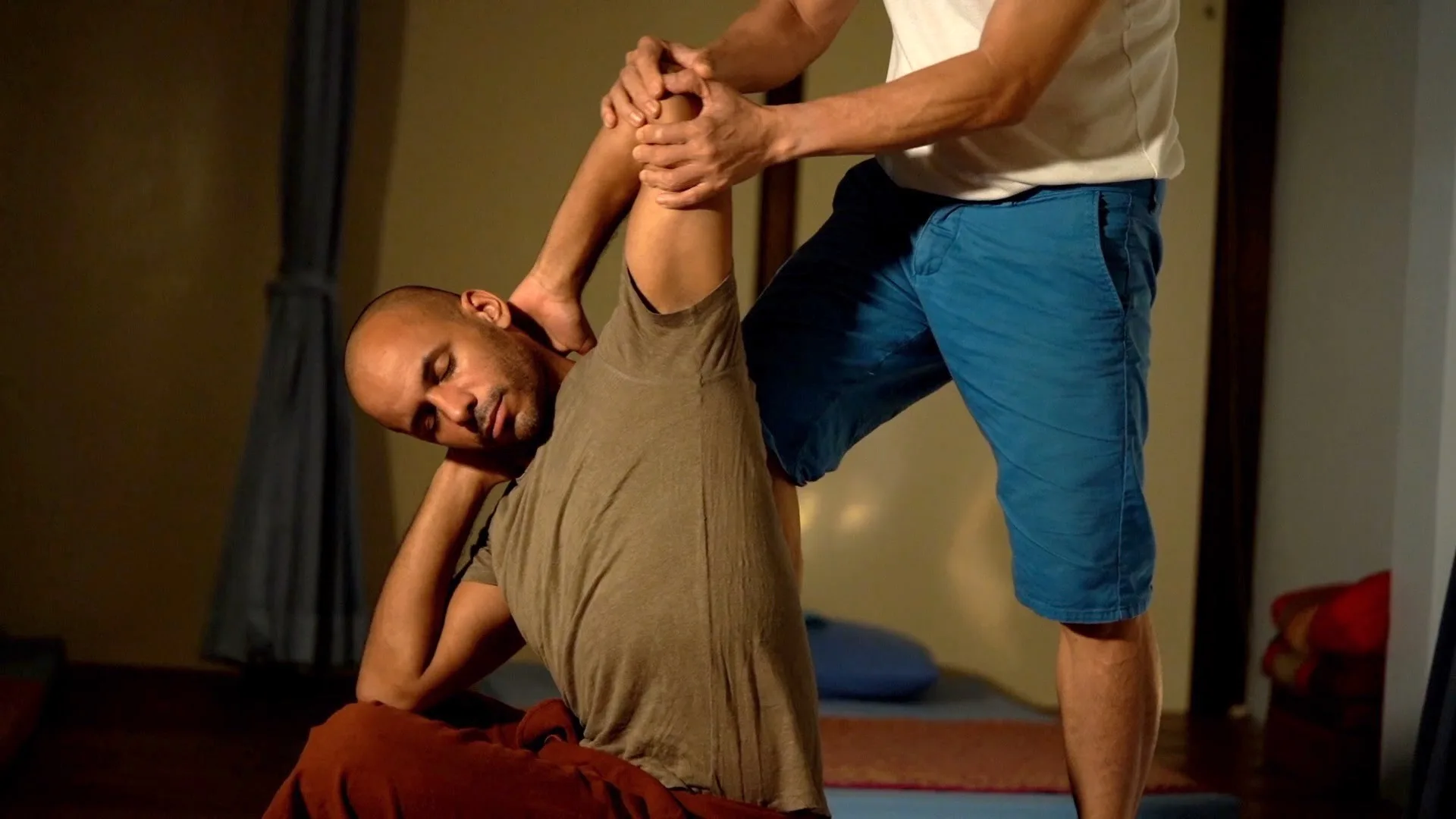
The Thara assessment maps this background tension — often so old the person no longer perceives it. Deep work releases the muscle chains and frees the breath; the most commonly reported effect after a few sessions is more restorative sleep, followed by returning daytime energy. Progress is tracked session by session, and the pace adapts to your energy level — never the other way round. Sessions are typically spaced out to let the body integrate the work rather than pile it on.
The mistakes that keep it going
Faced with fatigue, the usual strategies often turn against the body. Multiplying coffees keeps on alert a system that needs the opposite — and further degrades deep sleep. Launching into an intensive training plan "to get going again" deepens the deficit of a body that is not recovering. Weekend catch-up lie-ins shift the internal clock and make Monday harder. Cutting out all activity, conversely, deprives the body of the gentle movement that supports recovery. The common thread of these mistakes: forcing a broken-down machine instead of repairing the breakdown.
What to expect at the assessment
The assessment of persistent fatigue starts with the story: since when, in what context, what has been tried, what the medical work-up says. Then comes observation: posture, shoulder height, breathing range — breathing blocked high in the chest is a classic sign. Palpation then maps the background tension, often surprising for someone who "felt nothing". You leave with a clear reading, a protocol and a pace adapted to your current energy. And if any signal suggests an unexplored medical lead, you are told before any session.
FAQ
How do I know tension contributes to my fatigue? Clues: clenched jaw, raised shoulders, shallow breathing, inability to "let go" even on holiday. The assessment objectifies what you no longer feel.
Does sport drain or recharge? Gentle, regular activity improves energy; intensive training on a non-recovering body deepens the deficit. The order: recover first, intensify later.
How long before I feel a change? Sleep usually responds first, within a few sessions; daytime energy follows progressively.
Does winter play a role? Often: less light, less movement, a body contracting against the cold. If fatigue becomes clearly seasonal and marked, mention it to your physician as well.