Quick answer — Stress readies the body for action: contracted muscles, high breathing, clenched jaw. Held for months, this "alert" mode creates very real pain — neck, back, head — which itself becomes a source of stress. You can exit the loop through the body: a deeply relaxed muscle sends the brain a safety signal.
"It's stress": the diagnosis is often right, but incomplete. Because stress pain is not imaginary — it is muscular, measurable, and self-sustaining.
What stress concretely does to muscles
Facing a threat, the body prepares to act: shoulders rise, neck stiffens, jaw clenches, breathing shortens. A perfect reaction for a few minutes — harmful when the "threat" is a workload lasting months. Muscles held in semi-contraction develop painful tension points, high breathing robs the diaphragm of its calming role, and sleep degrades — see Sleeping badly because of body tension: what to do. The pattern is easy to spot in any open-plan office: shoulders up, jaws working, breath held before every delicate email.
The self-feeding loop
Established pain becomes a stressor in its own right: it worries, limits restorative activities, irritates. The brain, continuously receiving pain signals, keeps alert mode on — which re-tightens the muscles. At this stage, managing stress mentally is no longer enough: tension has taken on a life of its own in the tissues. That is why so many people who are relaxed "in their head" keep a knotted body. And the longer the loop runs, the less it needs the original trigger to keep going.
Breaking the loop through the body
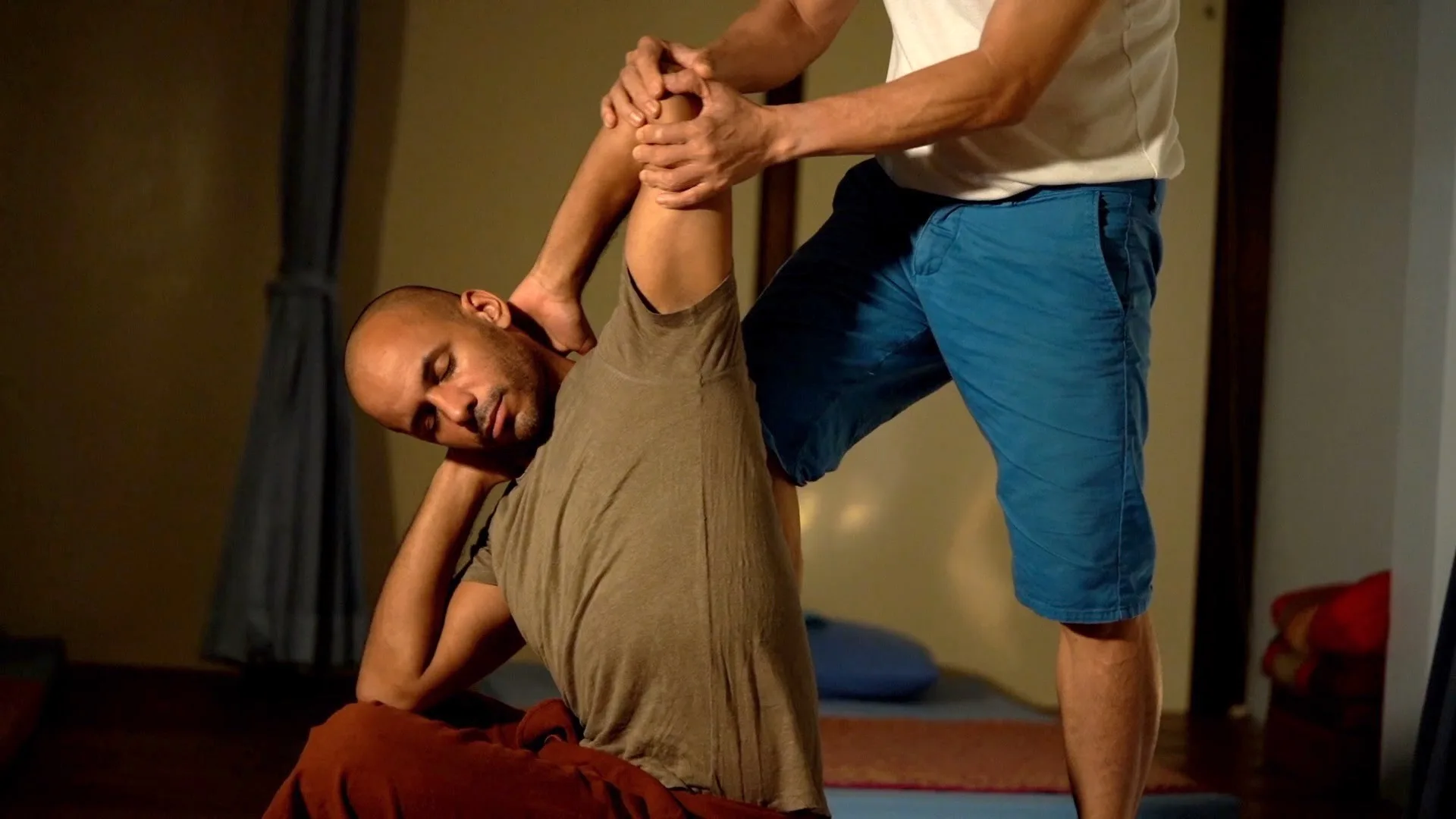
This is the principle of physical and mental stress reduction as we practise it: deep manual work that releases the body and, through that release, calms the mind. Relaxed muscles, recovered breathing: the brain finally receives a lasting safety signal. The protocol targets your own storage zones — identified at assessment — and their release builds from session to session, while the body relearns its baseline. Many clients describe the same milestone: the first week they catch their shoulders dropping on their own.
The mistakes that keep it going
Three traps come up constantly. Betting everything on the mind — meditation, organisation, holidays — while ignoring tissues that have taken on a life of their own: you come back from two weeks in the sun with the same shoulders. Masking the pain continuously with painkillers, without treating the tension producing it: the signal goes quiet, the cause keeps working. Seeking release in high-intensity sport on a body already on alert: that adds load to load. Moderate activity — walking, swimming, the weekend hike — does real good instead.
When should you see a doctor?
Some symptoms are not a matter for massage and call for prompt medical advice: chest pain, palpitations, unusual breathlessness, sudden unfamiliar pain, tingling or weakness in a limb. Likewise, if stress comes with a lastingly low mood, invasive anxiety or dark thoughts, the right person is your physician or a psychotherapist. The Thara assessment includes this triage from the first session: if your situation belongs with another professional, you are referred frankly — it is one of our commitments.
FAQ
Is my pain "in my head"? No. The trigger is psychological, but the muscle tension and pain are physiologically real.
Massage or psychotherapy? They complement each other: one works on the bodily loop, the other on psychological causes. Treating only one side often lets the other maintain the problem.
Why do I "store" everything in my neck? Neck, jaw and diaphragm are the reflex zones of vigilance; everyone has their own pattern, which the assessment reveals.
How many sessions before I feel a difference? Immediate relaxation is felt from the first session. Lasting change — a body that stays released between appointments — generally builds over a few weeks of regular follow-up.