
Quick answer — Patellofemoral syndrome is pain around or behind the kneecap, worsened by running, stairs or prolonged sitting. It usually stems from an imbalance in the muscle chains — quadriceps, hamstrings, glutes — that makes the kneecap track poorly in its groove. Rebalancing those tensions treats the cause.
It is the runner's most common injury, yet it also strikes hikers and desk workers: a dull ache around the kneecap, with no injury to blame.
How does it show up?
Pain circles or hides behind the kneecap. It flares walking downstairs, squatting, after a long sit — the "cinema sign" — or a few kilometres of running. A grinding or catching feeling may accompany bending. The knee is neither swollen nor unstable: it is a tracking problem, not structural damage.
Around here the typical story is familiar: the first spring runs, a hike with a long descent — it is almost always the downhill that wakes the knee — or the return to ski touring. On the office side, seated days shorten the thigh's muscle chains; the knee picks up the bill at the next effort.
Why does the kneecap rub?
The kneecap glides in a groove on the femur, guided by balanced muscle forces. A dominant outer quadriceps, weak glutes, shortened hamstrings, a collapsing foot arch: each imbalance slightly deviates the path. At thousands of bends per week, that small deviation becomes cartilage irritation. A stiff posterior chain often contributes — the same logic as in Plantar fasciitis: ending morning heel pain.
The word "syndrome" says it well: there is no single lesion to blame, but a set of forces to rebalance. In practice that is good news — what habits have tightened, targeted deep work can loosen. It also explains why imaging often looks unremarkable: the problem lives in the muscle chains, not on the scan.
Rebalance rather than rest
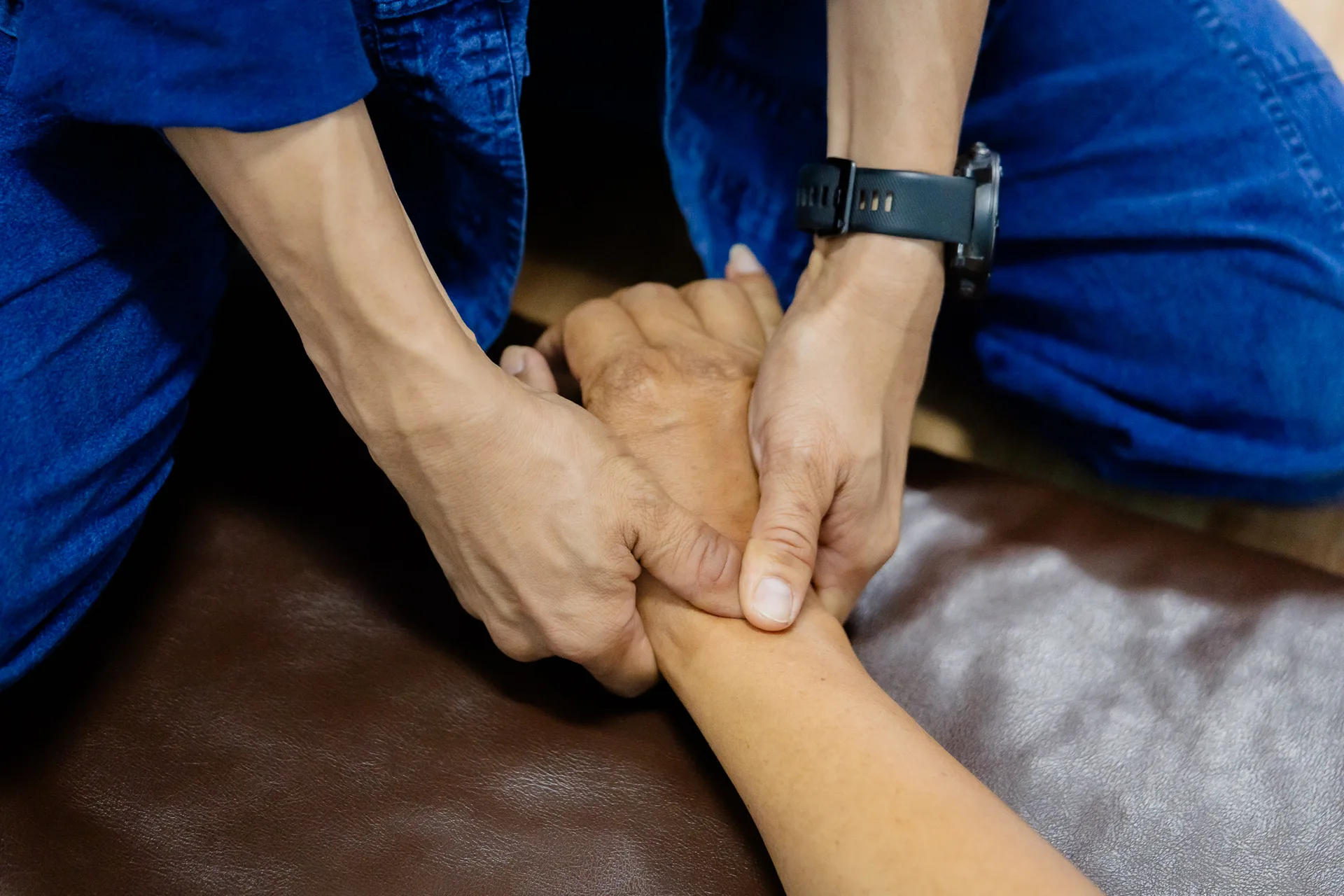
Rest calms the pain but realigns nothing. The Thara assessment maps lower-limb tension from pelvis to ankle; the protocol releases the dominant groups in depth, restores length to shortened chains and supports a progressive return to running with simple volume guidelines.
The individualised protocol evolves across sessions: dominant tensions shift as the chain rebalances, and the work follows that evolution. Sessions are spaced so the tissues can adapt, and each one starts by rechecking how the knee handled the previous week's load. Concrete guidelines frame the comeback — distance, elevation gain, frequency — so the knee absorbs the progression without relapse.
Self-care between sessions
Three habits complement the work done in the practice. Stretch the quadriceps and hamstrings after every outing, thirty seconds per group, without bouncing. Gently roll the outer thigh — usually the tightest — with a foam roller or a ball. Stand up every forty-five minutes at the desk to unstiffen the knee. Nothing spectacular: consistency is what protects the kneecap's tracking.
When should you see a doctor?
Patellofemoral syndrome does not swell and does not lock. A knee that puffs up, gives way, locks in flexion or aches at rest suggests another problem — meniscus, ligament, cartilage — and belongs with a physician. The same goes after trauma: a twist, a direct blow, a skiing fall. In those cases, imaging and medical examination come before any manual work.
FAQ
Will running through pain damage the knee? Mild pain that fades is not alarming; pain that grows during effort means easing off and treating the cause.
Is strengthening enough? Strengthening on top of unbalanced chains can entrench the problem. Release first, strengthen after.
Can the pain go away completely? That is the goal, without promising a timeline: progress depends on how long the imbalance has been there. Self-care and sensible volume progression consolidate the gains.
Should I change shoes? Sometimes helpful, never sufficient: kneecap tracking is mostly decided higher up, in hips and thighs.