
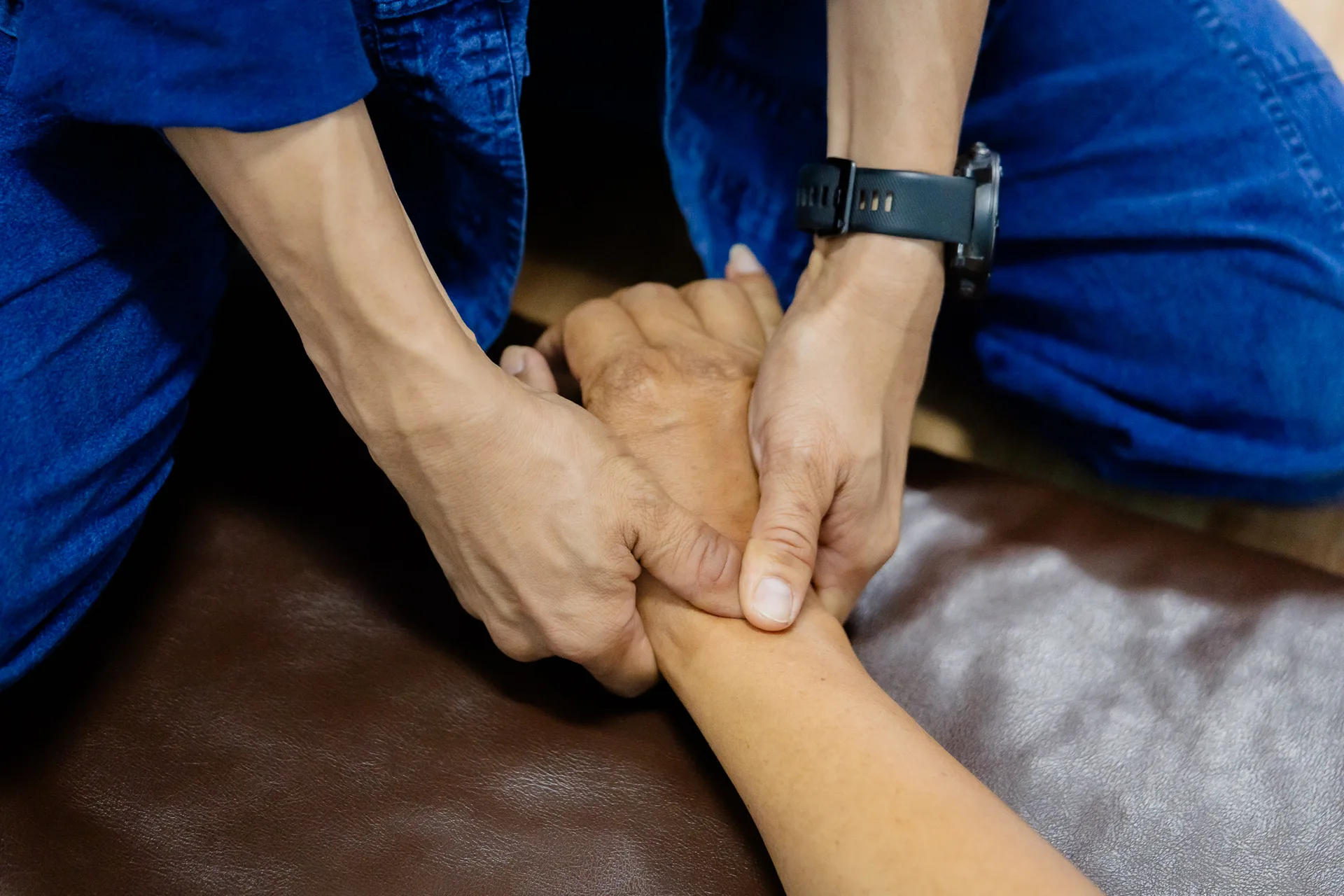
Quick answer — Tennis elbow (outer side) and golfer's elbow (inner side) are overuse tendinopathies: forearm muscle tendons become irritated at their bony insertion. Rest alone rarely fixes them, because the cause — overtight muscle chains — stays in place. Deep manual work on the forearm targets that origin.
You don't need to play tennis: a computer mouse, hand tools, carrying loads or playing an instrument are more than enough to trigger epicondylitis. Weekend DIY, spring hedge trimming, shopping bags carried at arm's length: the forearm absorbs it all, until the day the elbow objects.
Tennis elbow or golfer's elbow: what's the difference?
Both affect the elbow, at different spots. Tennis elbow (lateral epicondylitis) involves the wrist extensors — pain sits on the outside, flaring when you shake hands or lift a bottle. Golfer's elbow (medial epicondylitis) involves the flexors, on the inside. Either way, the tendon suffers where it anchors to the bone.
A simple test points the way: with the elbow straight, try lifting your hand against resistance. If the outer elbow lights up, the extensors are involved. Golfer's elbow shows up instead when gripping hard or flexing the wrist against resistance. Intensity varies: a faint ache at first, then pain creeping into trivial gestures — turning a key, lifting the coffee pot.
Why does the pain outlast every rest period?
Because rest calms the symptom without changing the mechanics. Forearm muscles remain shortened and stringy after months of repeated strain; once you resume, they pull on the same insertion again. It is the classic "it always comes back" pattern — the same mechanism as in Low back pain: why it always comes back.
The tendon itself repairs slowly, because its blood supply is poor. As long as the forearm's muscle chains stay overtight, every repeated gesture — mouse click, screwdriving, handshake — robs the tendon of the recovery it needs. Treating the cause therefore means releasing the pull upstream, not just soothing the sore spot.
How does the Thara protocol work?
The assessment identifies the muscle cords involved, from wrist to shoulder, and the triggering movements. Manual work then releases the whole chain in depth — not just the sore spot — so the tendon regains normal traction. Ergonomic and self-care advice consolidates results between sessions. The individualised protocol also reflects your job and hobbies: a carpenter, a graphic designer and a climber do not load the same muscle cords.
Self-care between sessions
Three simple habits extend the work done in session. One: gently massage the forearm from wrist to elbow, one to two minutes a day. Two: stretch the extensors — arm straight, palm down, easing the hand towards you, never into pain. Three: break up triggering gestures with micro-pauses every thirty to forty-five minutes, at the desk or the workbench. These habits maintain the release; they do not replace deep work.
When should you see a doctor?
Some signs fall outside simple epicondylitis: marked elbow swelling, intense night pain, tingling in the fingers, sudden loss of strength, or pain following a blow. These call for medical advice before any manual care. When in doubt, the Thara assessment starts precisely by ruling out those situations and referring when necessary.
FAQ
Can I keep working at a computer? Yes, with adjustments: forearm support, active breaks, a suitable mouse. Full rest is rarely required.
How many sessions will I need? It depends on how long the condition has been present. Recent cases evolve faster; progress is reassessed each session.
Can massage be combined with an injection? In principle, yes: the two approaches are not mutually exclusive. Mention it to both practitioners so session timing can be coordinated.
Ice or heat? Cold gives short-term relief in the irritated phase; later, heat helps relax the muscles. Neither treats the cause.